Optimize workforce operations across people and AI agents with
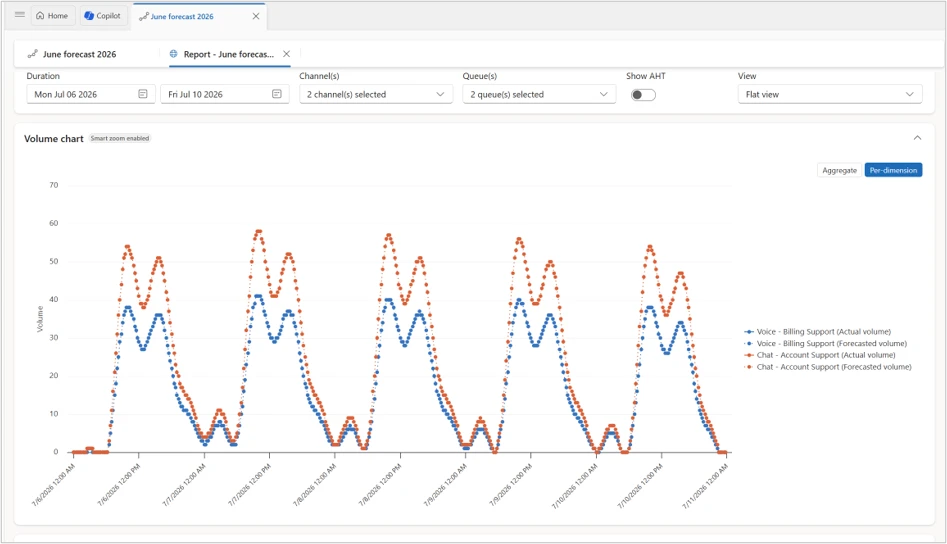
Workforce engagement management in Dynamics 365 helps organizations plan and manage a combined human and AI workforce, operate in real time, and continuously improve service quality.
People and AI working together optimize customer service
Customer service organizations are no longer managing people alone — they’re orchestrating service reps and AI agents working side by side. As AI takes on more work, leaders need a new way to plan, monitor, and improve performance across both human and digital labor.
Today, Microsoft is announcing general availability of workforce engagement management (WEM) in Dynamics 365 Customer Service and Contact Center designed specifically for this shift. It brings forecasting, scheduling, real-time operations, and quality management for both human and AI workforces into the service platform where the work happens.
This fundamentally resets how service operations are planned and managed.
Service leaders are under pressure to deliver exceptional customer experiences, respond to shifting demands, and raise quality standards. Yet many organizations still manage forecasting, scheduling, adherence, quality reviews, and coaching across disconnected tools and manual processes with legacy solutions that struggle to keep pace with modern service operations.
With workforce engagement management in Dynamics 365, organizations can run operations as a connected system. Built on the same data model as customer interactions and cases, workforce planning is grounded in actual service demand—not just historical volume—enabling more accurate forecasts, better staffing decisions, and more consistent service delivery. The result is a more precise, responsive operating model that helps organizations meet service levels, maintain quality, and scale AI, without adding complexity.
As an early adopter, we’ve worked closely with Microsoft to evaluate Workforce engagement management in Dynamics 365 against the rigor required in financial services. The platform’s ability to unify human and AI workforce planning, real-time operations, and quality management in one system is a clear differentiator. This supports our relationship-focused, customer and client-centric approach, while reinforcing our risk-disciplined operating model.”
— Jason Pope, EVP and Chief Technology Officer, Flagstar Bank
Plan with confidence
Workforce engagement management in Dynamics 365 starts with planning but in a fundamentally different way. Forecasts are built on real customer signals, including cases, conversations, and channel activity, rather than relying on disconnected inputs.
Capacity planning translates demand into staffing needs, allowing supervisors to model service representative capacity against service-level goals, handle times, concurrency, and operational assumptions.

From there, scheduling aligns the right customer service reps to the right work, shifts, and activities. Because planning and execution share the same foundation, organizations can better match staffing to demand, reduce variability in service levels, and create more predictable workloads for employees.
Evolve the human and AI workforce plan with AI Agent Estimator
As AI agents take on a growing share of service interactions, workforce planning must evolve to reflect a blended workforce.
AI Agent Estimator provides the ability to forecast AI agent capacity and projected consumption alongside human staffing. Planners can model how expected demand translates into both human effort and AI usage before those decisions impact operations or budgets.
This provides a more complete workforce plan, giving finance teams visibility into projected AI consumption, operations leaders the ability to balance human and AI capacity, and IT teams a way to validate assumptions ahead of scale.
Operate in real time: adherence and shift-based routing
Planning alone is not enough in an environment where conditions shift throughout the day.
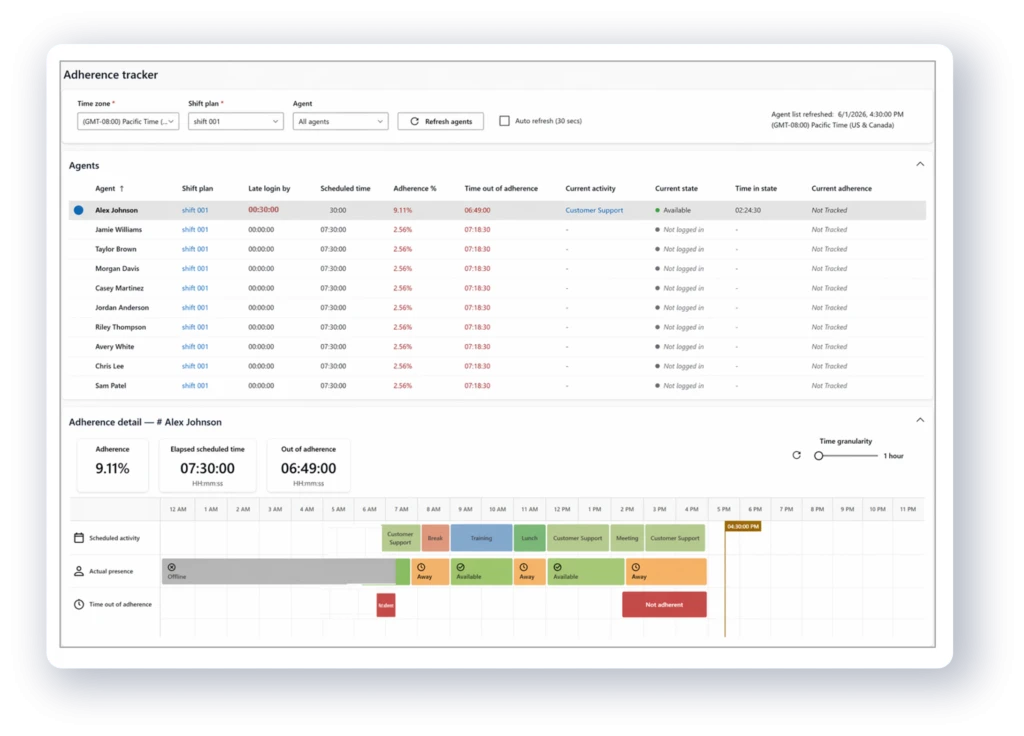
Real-time adherence provides visibility into how work is tracking against schedules, helping supervisors identify and respond to changes in agent activity, demand spikes, or service-level risk.
Shift-based routing connects workforce planning with service execution by aligning routing decisions to actual availability. Work is directed to customer service reps who are scheduled and ready, improving efficiency and reducing delays.
Together, these capabilities allow organizations to respond to demand as it happens, rather than reacting after service levels have already been impacted.
Move from manual spot checks to continuous quality improvement
Workforce engagement is not only about having enough people available. It is also helping with standards for empathy, compliance, resolution quality, and process execution.
Quality Evaluation Agent helps supervisors deliver more consistent, scalable quality oversight. Teams can define evaluation criteria, configure evaluation plans, and use AI-led assessment to evaluate customer interactions across cases and conversations, surfacing strengths, gaps, and coaching opportunities at scale. Because quality evaluation can use case context and operational data from Dataverse, it can assess service outcomes in the context of the customer record, not only the transcript.
Screen Recording adds another important signal: what happened on the screen while work was performed. For complex service interactions, quality depends not just on what was said, but on whether the rep followed the right steps across systems. Conversations, transcripts, and case notes explain what was said and documented, while screen context shows how the rep navigated systems, used knowledge, and completed the workflow.
Governance helps organizations turn policy expectations into consistent, explainable checks. Administrators can define policies in plain language and use them to evaluate whether customer communication is compliant, brand-safe, regionally appropriate, and aligned with company standards.
Coaching skills can convert quality signals into improvement plans by combining screen recording intelligence, governance outcomes, configured playbooks, evaluation rubrics, and gamification. Screen recording provides evidence of what happened, governance provides the policy signal, and playbooks define what should have happened.
The result is a closed-loop Quality Management model: capture screen and conversation context, evaluate with Quality Evaluation Agent and governance policies, coach with playbooks and improvement plans, motivate with gamification, and feed learning back into operations and workforce planning.

Built on the Microsoft cloud and Dynamics 365 platform
Workforce engagement management in Dynamics 365 works out of the box, with the flexibility to extend through the broader Microsoft platform as needs grow, from Dataverse and Teams to Power Platform, Copilot Studio, Azure AI, and Microsoft security and compliance foundations.
That breadth matters because WEM is not a standalone system that organizations have to wire together themselves. It is part of the service platform where customer interactions, workforce plans, quality signals, AI-assisted workflows, and collaboration come together in one operating model.
Bringing these signals together creates a stronger operating model for supervisors, customer service reps, and service leaders.
Adopt workforce engagement management on your terms
Organizations are at different stages in their workforce management journey. Some are ready to move quickly to native WEM capabilities in Dynamics 365. Others have existing workforce management investments and need a practical path forward.
Adapters for solutions such as Verint, Calabrio, NICE, and Alvaria help customers connect those existing systems with Dynamics 365 service operations, reduce integration friction, and transition to more native workforce engagement management capabilities over time.
Customers should not have to choose between modernization and continuity. Workforce engagement management in Dynamics 365 is designed to support both.
The next phase: agentic workforce engagement management
Over the coming few months, our workforce engagement management MCP tooling will make core workforce actions available through agent-ready tools across Microsoft 365 surfaces such as Service Agent, Teams, Copilot, and mobile. This will allow supervisors and service reps to complete high-value WEM tasks—such as viewing schedules, checking leave balances, submitting time-off requests, managing shift swaps, clocking in and out, and acting on approvals—all through natural language prompts, without needing to navigate the full Dynamics365 application.
By separating the WEM business capability from the user experience surface, WEM MCP tools will create a reusable foundation for key WEM features for mobile access, Copilot experiences, Teams workflows, and future agentic scenarios.
A better way to run service operations
Workforce engagement management in Dynamics 365 Customer Service and Contact Center brings planning, real-time operations, and quality management into the flow of service. The result is a more connected operating model for managing customer service reps and AI agents, with the flexibility to modernize over time.
Generally available today
Workforce engagement management in Dynamics 365 is generally available on June 30, 2026. It is included with Dynamics 365 Customer Service Enterprise and Premium SKUs, and available with Dynamics 365 Contact Center Voice + Digital SKU.
Next step: Learn more about workforce engagement management capabilities in Dynamics 365 on Microsoft Learn.
The post Optimize workforce operations across people and AI agents with Dynamics 365 appeared first on Microsoft Dynamics 365 Blog.