Managing Complex Service Work with Financial Clarity
Unifying service activity into a continuous, connected experience
Service work rarely happens in isolation. What looks like a single repair or maintenance visit is usually one step in a broader process that spans both service execution and financial tracking.
In many organizations, those two halves stay disconnected: work orders are completed in the field, while costs, revenue, and progress are tracked separately. The result is limited visibility into the true financial impact of service work as it happens and reconciliation after the fact instead of managing operational and financial data together in a single, continuous process.
Enabling a unified financial model for service work
At the end of January 2026, we introduced interoperability between Microsoft Dynamics 365 Field Service and Microsoft Dynamics 365 Project Operations generally available (GA), enabling service organizations to manage execution and financial outcomes as part of a single, connected model.
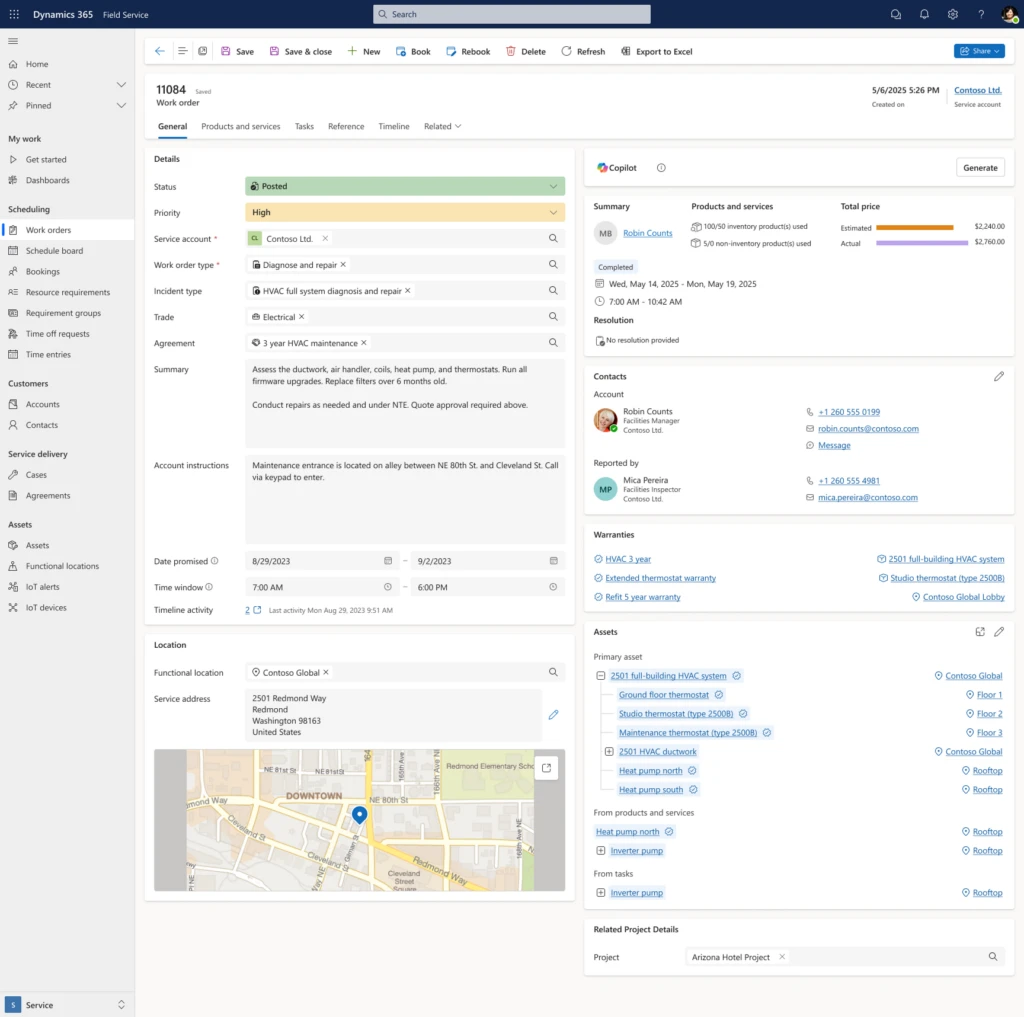
Within this model, work orders are no longer isolated, one-off transactions. They become part of a broader financial and operational framework that connects service activity over time. Organizations can maintain a continuous view of work performed across assets, contracts, or long-running service engagements while improving financial visibility, operational traceability, and billing accuracy.
For more information about the GA release, see the release plan documentation:
- Connect Field Service to finance and operations
- Link work orders to projects for unified financials
- Enable serialized inventory tracking between Field Service and finance and operations
Contoso scenario: managing parts usage across a project
Consider Contoso Energy Services, a provider that installs and maintains industrial refrigeration systems for large grocery chains. Their work often involves multi-week preventive maintenance, complex repairs, and large-scale equipment installations, scenarios where coordinating service execution and financial tracking is critical.
In this example, Northwind Grocers engages Contoso to replace refrigeration equipment across multiple store locations. Contoso structures the engagement under a project contract, with contract lines defining how parts used during installation and maintenance are priced and billed
Contoso creates a project representing the overall equipment replacement program. This project serves as the financial structure for the engagement, tracking service activity across multiple locations and work orders within a single, governed view.
Contoso then executes individual store visits through work orders linked to this structure. For example:
- Work order – replace refrigeration parts at Store #102
- Work order – replace refrigeration parts at Store #118
Planning material usage before execution
Before technicians arrive on site, the team captures the parts they expect to use as estimates on the work order. For Store #102, this includes two refrigeration compressors and four refrigerant valves.
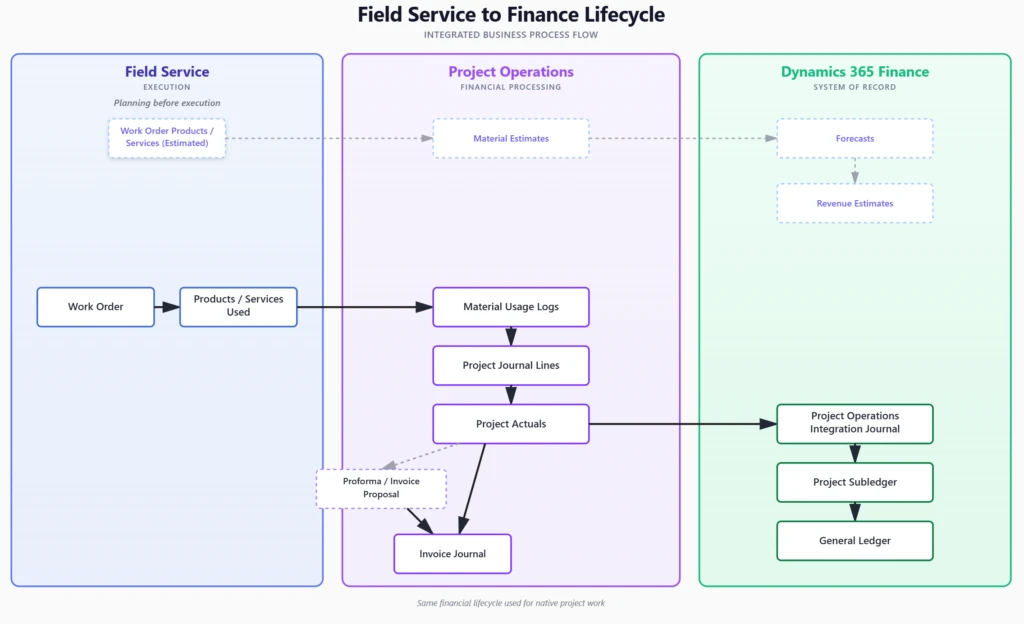
Once entered, these estimated quantities automatically flow from the work order into Project Operations, where they appear as material estimates on the associated project.
In Project Operations and Dynamics 365 Finance deployments, those material estimates also generate demand forecast lines.
Converting parts usage into financial transactions
Technicians record the parts they use directly on the work order as they complete the work. Through the interoperability, this usage is translated into financial records within the project. Material usage is processed through standard approval workflows and recorded as project actuals, representing the financial impact of materials consumed during service execution.
Tracking project profitability
As work orders progress across multi-month installations, the financial impact becomes continuously visible throughout execution. This gives organizations an ongoing view of profitability, so they can track performance as work progresses spot trends early, such as parts consumption running ahead of estimate, cost overruns, or margin erosion, while the engagement is still in flight.
Posting transactions to finance
After approval, the system creates project actuals linked to the appropriate contract line accurately reflecting the financial impact of the completed work. From here, the invoicing and posting process depends on the organization’s deployment model.
Project Operations Core deployments: Contoso uses actuals to generate a draft pro forma invoice within Project Operations. This invoice previews what will be billed, and users can review and finalize it directly in Project Operations.
Project Operations and Dynamics 365 Finance deployments: Approved actuals are transferred to Dynamics 365 Finance through the Project Operations Integration Journal. Finance users can review and post these transactions, then handle invoicing within Finance.
Organizations working with other ERP systems can apply a similar pattern to transfer approved financial data for downstream invoicing and posting.
Once processed, transactions flow into the project subledger and then into the general ledger.
Capabilities enabled by the Field Service and Project Operations interoperability
These capabilities connect planning, execution, and financial processing within a single operating model.
Service work no longer generates disconnected operational records that require downstream reconciliation. Instead, execution flows through a unified financial lifecycle, from estimates and forecasts to actuals, invoicing, and revenue recognition.
| Capability | What Happens |
| Multi-Work Order Project Linking | Multiple Work Orders including Field Service Agreement-generated work can be linked to a single Project, so reactive and planned service contribute to the same project delivery. |
| Project Reassignment | A Project can be updated or removed from a Work Order before financial posting if the wrong project was initially selected. |
| Organization-Level Pricing Source | Organizations can configure whether pricing originates from Dynamics 365 Field Service or Dynamics 365 Project Operations |
| Support for Discount % | Discounts % applied on the work order line flow through to financial records and invoicing. |
| Material Estimates from Work Orders | Estimated quantities entered on Work Order products are reflected as material estimates in Project Operations, providing early visibility into expected costs and revenue. |
| Material Usage to Project Actuals | When Work Order products and services are marked as used, they are captured as material usage logs in Project Operations, once approved, generate project actuals representing the financial impact of the work performed. |
| Quantity Used vs Quantity Billed | Technicians can record the quantity used while billing for a different quantity. |
| Configurable Approval Controls | Material transactions can be approved manually or automatically, depending on what works best for your organization. |
| Mobile Offline | Technicians can capture material usage offline and sync once connectivity returns. |
| Finance-Controlled Inventory Dimensions | In deployments that use Project Operations and Finance, Work Order transactions respect finance-defined sites, warehouses, and financial dimensions. |
| Serial and Batch Inventory Traceability | In deployments that use Project Operations and Finance, parts tracked through serial and batch control remain traceable across service and financial records. |
Deployment models and modern architecture alignment
The Field Service and Project Operations interoperability supports multiple deployment models, allowing organizations to align with their broader operational and financial landscape.
Organizations can choose how they structure financial management and system ownership within Dynamics 365 or other ERP systems while maintaining a consistent operating model for service execution.
Project Operations Core: In this model, Project Operations manages project financials and invoicing, while Field Service remains the system of record for inventory.
Project Operations and Finance deployments: In this model, Finance and Supply Chain Management become the system of record for inventory and accounting. Finance processes financial postings and final invoicing, while Field Service and Project Operations manage operational execution and track project financials.
Both deployment models rely on the modern Project Operations architecture, which introduces a structured financial hierarchy designed for service-centric operations.
PMA guidance and manufacturing deployments
The Field Service and Project Operations interoperability relies on the modern Project Operations architecture, where PMA projects are largely read-only and limited to financial activities. As a result, transactions post only to modern Project Operations projects, not PMA projects. Use modern projects for service-based scenarios and keep PMA projects for reference or limited financial activities.
Learn more: Move to the modern architecture
Ready to get started?
Please visit our learn more documentation: Set up Field Service interoperation with Project Operations. For detailed licensing guidance, see the Dynamics 365 licensing documentation.
The post Managing Complex Service Work with Financial Clarity appeared first on Microsoft Dynamics 365 Blog.