Build a connected foundation for Supplier Engagement and agentic AI
Summary
Supplier Engagement in Microsoft Dynamics 365 Supply Chain Management helps organizations connect supplier experiences, procurement processes, and business data in a single, extensible environment. Built on Microsoft Power Platform, it enables more consistent supplier management while providing the connected business context and governance needed to support AI and agent-driven procurement scenarios.
Giving suppliers better digital experiences shouldn’t require IT teams to create another disconnected system to manage. As organizations introduce AI and agents into business processes, that becomes even more important. Agents need access to business data and context, while organizations need to maintain the security, permissions, policies, and controls that govern how work gets done.
Supplier processes illustrate this challenge. Supplier information and interactions can span registration and qualification, sourcing, purchasing, invoicing, and ongoing supplier management. When those interactions take place across separate portals, email, and disconnected tools, organizations can end up with fragmented supplier information and additional integration and governance requirements.
Supplier Engagement in Microsoft Dynamics 365 Supply Chain Management is available in public preview and is designed for composability, helping organizations bring supplier interactions into a more connected environment.
Built using Microsoft Power Platform and as part of Dynamics 365 Supply Chain Management, Supplier Engagement extends how suppliers and procurement teams interact with strategic and operational source-to-pay processes while keeping those interactions connected to operational data and processes in Dynamics 365.
This approach gives organizations the flexibility to adapt supplier experiences to their business requirements while maintaining the connection to the enterprise resource planning (ERP) processes, data, and controls that support procurement operations.
For CIOs and IT teams, as well as sourcing and procurement teams, this provides a composable approach to supplier engagement today and can help establish the connected data, business context, and governance foundation needed as AI and agents become increasingly integrated into business processes.
Connect supplier experiences to the processes that run your business
Suppliers need accessible ways to register, maintain information, respond to requests for quotation (RFQs), confirm purchase orders, submit invoices, and collaborate with procurement teams. Traditionally, supporting these supplier experiences can mean adding supplier-facing systems and then integrating them with ERP systems.
Supplier Engagement takes a more connected approach. Microsoft Power Platform capabilities, including Dataverse, model-driven Power Apps, and Power Pages, support experiences tailored to suppliers and procurement teams. Suppliers can interact through a supplier portal, while procurement teams can manage supplier information and lifecycle activities through Supplier Engagement. Dynamics 365 Supply Chain Management remains the foundation for operational procurement processes and legal-entity transactions.
For IT teams, this architecture provides flexibility in how supplier experiences are delivered and extended while maintaining connections to the ERP processes and data that support procurement operations.
High-level logical architecture
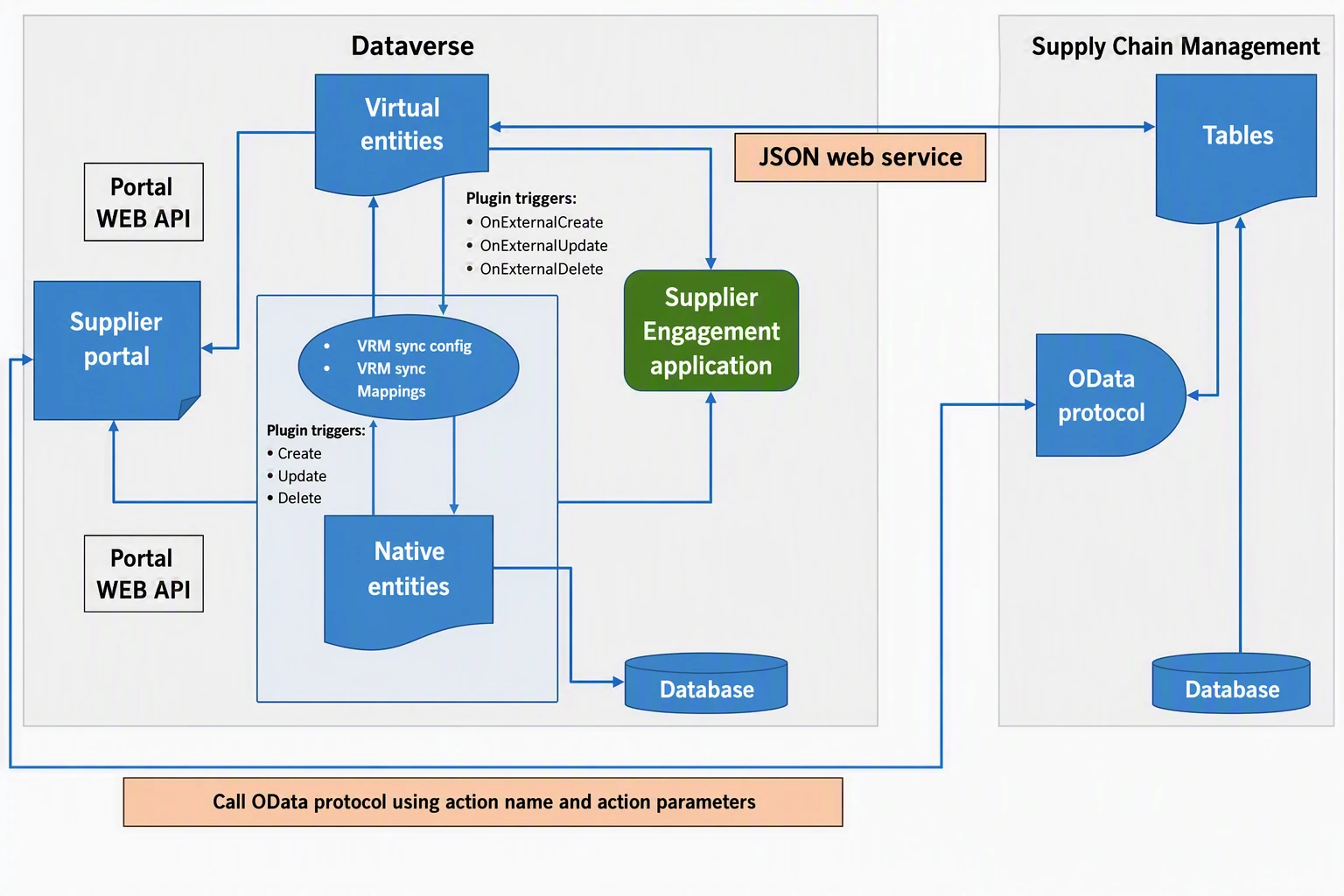
Figure 1: Supplier Engagement architecture showing supplier and procurement experiences connected through Microsoft Power Platform to Dynamics 365 Supply Chain Management
Create a more consistent view of suppliers across the organization
A connected supplier experience depends on connected supplier information. This can be particularly challenging for organizations operating across multiple legal entities, where the same supplier may do business with different entities and business units of the organization.
Maintaining supplier information separately for each legal entity can contribute to duplicate information, inconsistent records, and additional administrative work. It can also make it more difficult to establish the consistent business context needed for analytics, AI, and agents.
Global vendor management in Supplier Engagement provides a shared supplier profile where information such as contacts, addresses, certifications, capabilities, and organizational details can be maintained centrally. Following the appropriate qualification and approval processes, relevant supplier information can then be released into one or more legal entities in Dynamics 365 Supply Chain Management for operational transactions.
This approach can help organizations establish a more consistent supplier identity across the business while continuing to support the legal-entity structures required for procurement operations.
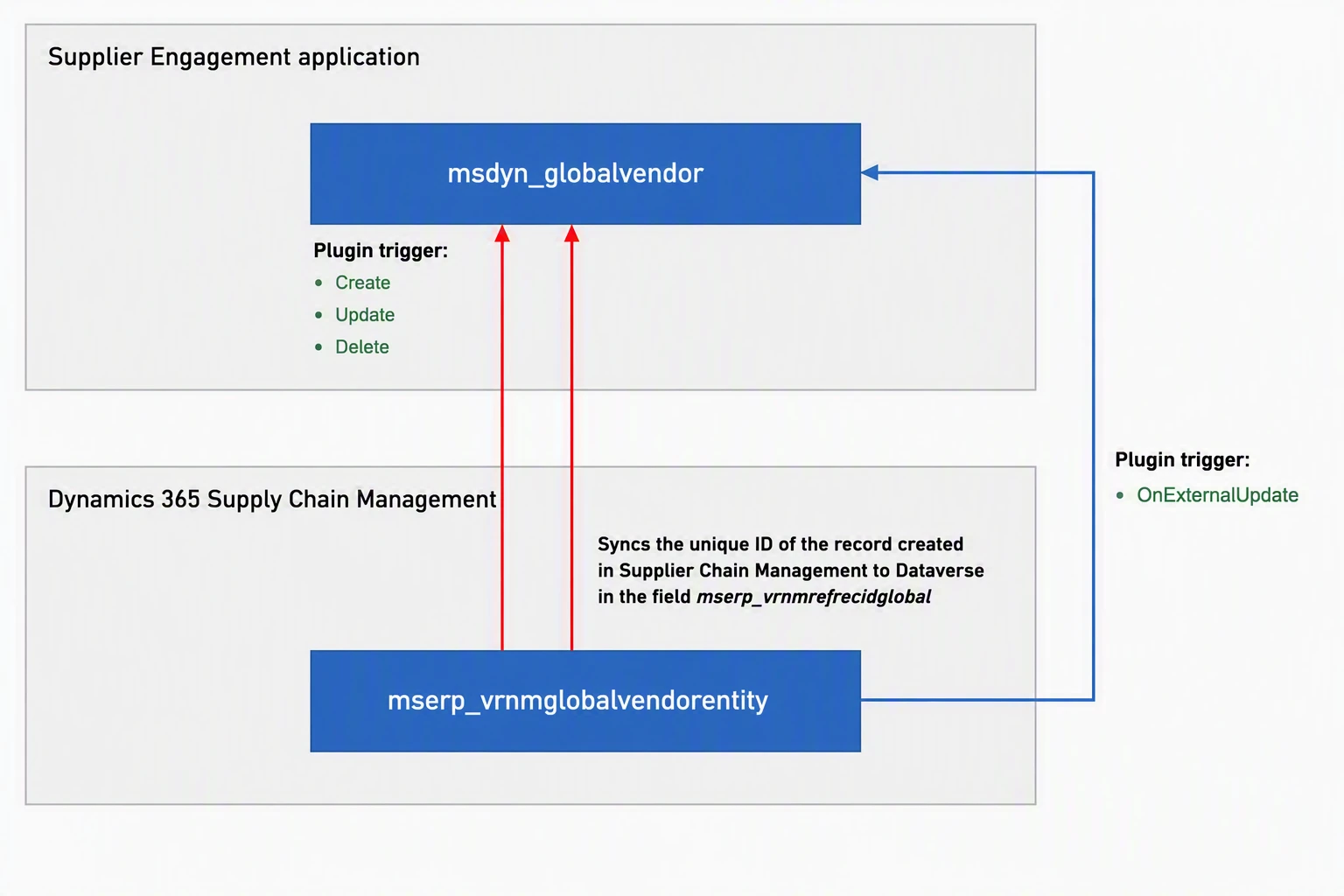
The following illustration shows the data flow between the Supplier Engagement app and Dynamics 365 Supply Chain Management for global vendor records. When you create, update, or delete a global vendor record in the Supplier Engagement application, plugins trigger on the msdyn_globalvendor Dataverse table and synchronize the changes to the mserp_vrmglobalvendorentity entity in Dynamics 365 Supply Chain Management.
When you update the entity in Dynamics 365 Supply Chain Management, an OnExternalUpdate plugin triggers and synchronizes the changes back to Dataverse.
Adapt supplier experiences with Microsoft Power Platform
Supplier requirements rarely remain static. Organizations may need to change onboarding processes, capture additional information, adapt experiences for different supplier groups, or extend processes as business requirements evolve.
Supplier Engagement uses Microsoft Power Platform to provide an extensible foundation for these experiences. Dataverse supports the engagement data model, while Power Apps and Power Pages provide experiences for procurement teams and external suppliers. Organizations can build on these capabilities to adapt Supplier Engagement to their requirements while maintaining connections to Dynamics 365 Supply Chain Management.
For organizations already using Microsoft Power Platform, this also means Supplier Engagement can become part of a broader approach to application development, extensibility, and governance rather than introducing another technology environment for IT teams to manage.
This composable approach can give organizations greater flexibility to evolve supplier experiences as requirements change while keeping those experiences connected to the ERP processes they support.
Maintain control over data and process boundaries
Composability becomes more valuable when IT teams can maintain clear boundaries around data ownership and operational processes.
Supplier Engagement uses event-driven synchronization and configurable mappings to connect supplier information in Dataverse with Dynamics 365 Supply Chain Management. Virtual entities can make Dynamics 365 Supply Chain Management data available through Dataverse without requiring the underlying operational records to be copied into Dataverse, while APIs and OData actions connect supplier interactions with relevant Dynamics 365 Supply Chain Management processes.
Administrators can configure mappings for the data that needs to move between Supplier Engagement and Dynamics 365 Supply Chain Management. Dynamics 365 Supplier Engagement uses synchronization capabilities designed for its supplier data and process model, which are distinct from standard dual-write. Organizations should not configure both mechanisms for the same Supplier Engagement entities because doing so can result in duplicate records and make data ownership more difficult to manage.
These capabilities give IT teams tools to define data ownership and synchronization boundaries based on their architecture and business requirements while keeping operational procurement processes anchored in Dynamics 365 Supply Chain Management.
Build the business context agents need
As organizations introduce agents into business processes, the quality of the underlying business context becomes increasingly important. Agents need more than access to data. They need to understand the context surrounding that data, including the supplier relationship, where work is within a process, and the permissions, policies, approvals, and business rules that apply.
Disconnected supplier information makes that context more difficult to establish. Bringing supplier information and interactions into a connected environment with Dynamics 365 Supply Chain Management can help establish a stronger data and process foundation for AI and agents.
Supplier Engagement helps connect supplier information and experiences with the operational procurement processes in Dynamics 365. As organizations evaluate agentic scenarios across procurement and supplier management, this foundation can provide agents with access to relevant supplier and process context while helping organizations maintain the permissions and controls established for their ERP environment.
This becomes increasingly important as AI evolves from helping people find and summarize information toward agents that can participate in business processes. The opportunity is not simply to give agents access to more data. It is to provide the business context they need to support work within the processes and controls an organization has established.
Prepare supplier processes for what comes next
The question is no longer simply how to provide another digital experience for suppliers. It is how to extend supplier processes without creating additional fragmentation while preparing the organization’s data and architecture for a future in which people and agents increasingly work across business processes.
Supplier Engagement brings together the operational foundation of Dynamics 365 Supply Chain Management with the extensibility of Microsoft Power Platform. Organizations can adapt supplier experiences to meet business requirements, connect supplier information across procurement processes, and maintain control over how those experiences interact with ERP data and processes.
As organizations adopt more AI and agentic capabilities, this connected foundation becomes increasingly important. Bringing together supplier information, business context, extensibility, and governance can help organizations prepare supplier processes for an agentic future while continuing to support the procurement requirements they have today.
Explore Supplier Engagement to learn how the public preview can help connect supplier experiences, data, and procurement processes.
The post Build a connected foundation for Supplier Engagement and agentic AI with Microsoft Dynamics 365 Supply Chain Management appeared first on Microsoft Dynamics 365 Blog.