Breaking the Company Boundary: Cross-Legal-Entity Fulfillment and
Private Preview: Dynamics 365 version 10.0.48
Public Preview: Dynamics 365 version 10.0.49
Disclaimer: The capabilities described here are in preview. Preview features are provided for evaluation only, are subject to change, and may not be released in their current form. Availability, timing, and functionality of any feature described here, including roadmap items and capabilities not yet generally available, are not guaranteed and should not be relied upon when making purchasing decisions.
Inventory is often available, just not in the company where demand shows up. A customer may place an order in one legal entity while the best available stock sits in another. When that happens, teams often fall back on manual intercompany coordination, which slows fulfillment and adds operational cost.
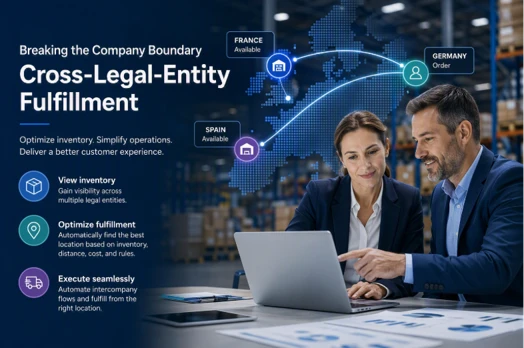
Cross-Legal-Entity Fulfillment Optimization in Dynamics 365 helps remove that barrier. By combining Distributed Order Management (DOM) with automated intercompany orchestration, the system can evaluate inventory across participating legal entities, help identify a suitable fulfillment location, and create the required transactions automatically.
In practice, fulfillment decisions can be based on the right business signals, such as inventory availability, distance, cost, and sourcing rules, instead of being limited by company boundaries.
For example, a retailer with separate legal entities in Germany, France, and Spain may receive an order in Germany when the local entity is out of stock. With this capability, DOM can identify available inventory in France, create the required intercompany flow, and route fulfillment to a suitable location. The customer gets a smooth order experience, while the retailer makes better use of inventory across the enterprise.
What we’re releasing
Cross-Legal-Entity Fulfillment Optimization introduces five core capabilities:
- Cross-LE fulfillment groups: Define fulfillment groups that include warehouses and stores across multiple legal entities, so DOM can evaluate a broader enterprise network instead of a single company.
- Cross-LE inventory visibility for optimization: Allow DOM to evaluate inventory availability from participating legal entities and source from a larger inventory pool.
- Enhanced fulfillment profiles and rules: Support multi-entity fulfillment strategies while preserving entity-specific configuration, such as delivery modes and sales order origins. You can define fulfillment logic once and apply it consistently across entities.
- Automated intercompany transaction orchestration: When inventory is sourced from another entity, the system creates the required intercompany transaction chain automatically.
- Cross-entity fulfillment execution: Orders sourced from another legal entity can be fulfilled through familiar execution experiences while remaining synchronized across participating entities.
How it works
Cross-Legal-Entity Fulfillment Optimization is a headless capability provided by Dynamics 365 Commerce and available in Dynamics 365 Finance and Operations (HQ). As long as orders are created in, or synchronized to, Finance and Operations, DOM can evaluate fulfillment options across participating legal entities and orchestrate the required fulfillment process.
The initial release supports retail orders. Support for broader Supply Chain Management sales order scenarios is planned on the roadmap. Roadmap items are subject to change and are not a commitment to deliver.
When DOM determines that inventory should be sourced from another legal entity, it orchestrates the intercompany transaction flow: the Original Sales Order (OSO), the Intercompany Purchase Order (IC PO), and the Intercompany Sales Order (IC SO). These documents remain synchronized throughout the fulfillment lifecycle.
Fulfillment teams continue to use standard processes such as picking, packing, shipping, invoicing, and rejection handling. Status updates flow through the chain so each participating entity stays aligned. If a location rejects an order or inventory constraints change, fulfillment can be reassessed and optimized again using current conditions.
The goal is a flow that feels seamless for operations while still preserving the controls, accounting, and intercompany structures that enterprises require.
Business benefits
- Increase inventory utilization: Make inventory usable across entities and reduce situations where stock exists but cannot satisfy demand.
- Optimize fulfillment decisions: Let the engine choose the optimal location based on availability, distance, rules, and constraints, across participating legal entities.
- Reduce manual effort: Automate intercompany transaction creation and ongoing synchronization.
- Improve the customer experience: Increase fulfillment flexibility and help satisfy demand faster and more consistently.
- Create a connected enterprise network: Move from isolated legal entity processes toward a more unified fulfillment strategy.
From visibility to fulfillment: an end-to-end cross-legal-entity solution
Cross-Legal-Entity Fulfillment Optimization follows Cross-Legal-Entity Inventory Lookup, released in 10.0.47. That earlier capability gave store associates the ability to see inventory across legal entities. Together, the two capabilities create a more complete cross-legal-entity flow, from visibility through fulfillment.
The progression is simple: see inventory across legal entities, optimize fulfillment across legal entities, and execute fulfillment across legal entities.
This helps organizations move beyond simply viewing inventory in another entity. They can act on it through intelligent optimization and automated execution, which is an important step toward a more connected fulfillment model across participating legal entities.
Getting started
Configuration builds on existing Distributed Order Management capabilities:
- Enable Distributed Order Management and Azure Maps.
- Establish intercompany trading relationships between participating legal entities.
- Configure DOM Intercompany Vendor Mapping.
- Define fulfillment groups that span participating legal entities.
- Configure fulfillment profiles and rules.
- Schedule the DOM processing jobs.
Full configuration steps, fulfillment scenarios, and troubleshooting guidance are available in the product documentation.
Availability
| Availability | |
| 10.0.48 | Private Preview |
| 10.0.49 | Public Preview |
Customers in the 10.0.48 private preview can contact the product team for enablement by creating an ICM with their environment details. Beginning with the 10.0.49 public preview, customers can self-enable the feature through Feature Management.
Looking ahead
Cross-Legal-Entity Fulfillment Optimization is more than a new feature. It is an early step toward more connected fulfillment across participating legal entities.
Today, the capability supports Commerce sales orders across channels, including POS, e-commerce, call center, and headless orders through Commerce Scale Unit (CSU). We have also heard a clear ask from customers: make this compatible with Supply Chain Management (SCM) sales orders as well, so the same cross-legal-entity fulfillment approach can work for all sales order types.
Cross-legal-entity inventory visibility for customer-facing e-commerce experiences is another area we are evaluating. Roadmap plans are subject to change and are not a commitment to deliver.
We are already looking into that direction. If SCM sales order support is important for your business, please reach out. We would like to understand your requirements.
How to enable and share feedback
- Have feedback?: Leave a comment or reach out to me directly.
- Want to try it on 10.0.48 private preview? Raise an incident to request flight enablement and include your environment details. In 10.0.49 public preview, you can self-enable through Feature Management, so no incident is needed.
Also recent release: DOM support for advanced warehouse items (10.0.46)
DOM now supports advanced warehouse-enabled items, allowing them to participate in sourcing and fulfillment optimization scenarios where they were previously excluded. This expands the inventory DOM can evaluate and helps organizations apply fulfillment optimization more consistently across products managed with advanced warehouse processes.
DOM is also compatible with advanced warehouse scenarios where inventory availability is correctly calculated with inventory statuses enabled, and where warehouse work, loads, and shipments align with the fulfillment strategy.
One inventory network. Multiple legal entities. One intelligent fulfillment decision. That is the future we are building toward.
The post Breaking the Company Boundary: Cross-Legal-Entity Fulfillment and Advanced Warehouse Support in DOM appeared first on Microsoft Dynamics 365 Blog.